UX/UI Analysis
Comprehensive analysis results in a prioritized summary of findings and recommendations.
Services
Usability Heuristics
A heuristic evaluation is one of the most efficient ways to identify usability problems in an existing product. Rather than waiting for users to surface issues through testing, a trained UX expert evaluates your product against a set of established usability principles to identify friction, inconsistency, and missed opportunities before they cost you users or development cycles. For enterprise software and B2B SaaS products with complex interfaces and high-stakes workflows, a heuristic evaluation surfaces problems that internal teams are too close to the product to see.
Principles
Heuristic evaluations at Ursa Design are conducted against Jakob Nielsen's ten usability heuristics, which are the most widely recognized and empirically validated framework for evaluating digital product interfaces. Nielsen's principles cover visibility of system status, match between system and the real world, user control and freedom, consistency and standards, error prevention, recognition over recall, flexibility and efficiency of use, aesthetic and minimalist design, error recovery, and help and documentation. Each principle is evaluated systematically across your product to produce a comprehensive picture of where the experience succeeds and where it breaks down.
Parameters & Goals
Every heuristic evaluation begins by defining the scope, parameters, and goals of the analysis. Which user types are we evaluating for? Which workflows and task flows are in scope? What are the known pain points the team wants validated? Setting clear parameters ensures the evaluation produces targeted, actionable findings rather than a generic list of observations and gives stakeholders a clear framework for understanding and prioritizing the results.
Accessibility Audit
Digital products that fail to meet accessibility standards exclude users with disabilities, expose organizations to legal risk, and consistently underperform on usability metrics for all users, not just those with specific needs. For enterprise software teams and B2B SaaS products serving diverse user bases, an accessibility audit is both a compliance requirement and a product quality investment.
WCAG
Accessibility audits at Ursa Design are conducted against the internationally recognized standard for digital accessibility, the Web Content Accessibility Guidelines. WCAG defines three levels of conformance: A, AA, and AAA. Most enterprise software and B2B SaaS products are required to meet WCAG 2.1 AA as a minimum standard, and audits are scoped accordingly. Your product is evaluated against the specific criteria your organization and user base require.
Automated Testing & Manual Evaluation
Accessibility audits begin with automated testing tools that rapidly surface a baseline of detectable issues across your product: missing alt text, improper heading structures, insufficient color contrast ratios, and missing form labels. Automated testing identifies approximately thirty percent of accessibility issues. The remaining issues require manual evaluation by an experienced reviewer who can assess context, interaction patterns, and user experience in ways no automated tool can replicate.
Keyboard Navigation & Screen Readers
Full keyboard navigability is a requirement for WCAG compliance and a critical usability standard for users who cannot use a mouse. Manual keyboard navigation testing verifies focus order, focus visibility, and the ability to complete all key workflows without a pointing device. Screen reader compatibility testing evaluates how assistive technologies like NVDA, JAWS, and VoiceOver interpret and communicate your interface to users who are blind or have low vision. This surfaces issues with semantic markup, ARIA labels, and dynamic content announcements that automated tools routinely miss.
Color Contrast
Color contrast evaluation ensures text, icons, and interactive elements meet the minimum contrast ratios required by WCAG 2.1 AA (4.5:1 for normal text and 3:1 for large text and UI components). Beyond compliance, contrast evaluation improves readability for all users across a range of lighting conditions and display types, making it one of the highest impact accessibility fixes available to most product teams.
Usability Testing
A heuristic evaluation tells you where expert analysis identifies problems. Usability testing tells you where real users actually struggle. Together they produce a complete picture of your product's experience gaps. For enterprise software with specialized user types and complex task flows, recruiting the right participants is as important as the test itself.
Recruiting Target Users
Effective usability testing requires participants who reflect your actual user base. Participant recruitment is scoped to your specific user types, ensuring that findings reflect the experiences of the people your product is built for rather than a convenient but unrepresentative sample. For accessibility-focused testing, recruiting participants who use screen readers, alternative input devices, or other assistive technologies produces findings that automated tools and expert review alone cannot surface.
Prototyping
Where the existing product has known gaps or proposed fixes to validate, interactive prototypes are built to test specific solutions before committing to development. Prototyping at this stage allows your team to validate that proposed design changes actually resolve the issues identified in the heuristic evaluation and accessibility audit rather than assuming they will and discovering otherwise after engineering has already built them.
Test Moderating
Moderated usability testing sessions are facilitated directly with recruited participants. Ursa Design observes how real users interact with your product or prototype, capturing where they struggle, and probing the reasoning behind their behavior. Moderated sessions are conducted in-person or remotely and are recorded for team review. Structured facilitation ensures sessions stay focused on the goals defined in the evaluation parameters while remaining open to unexpected findings that surface organically during the session.
Report
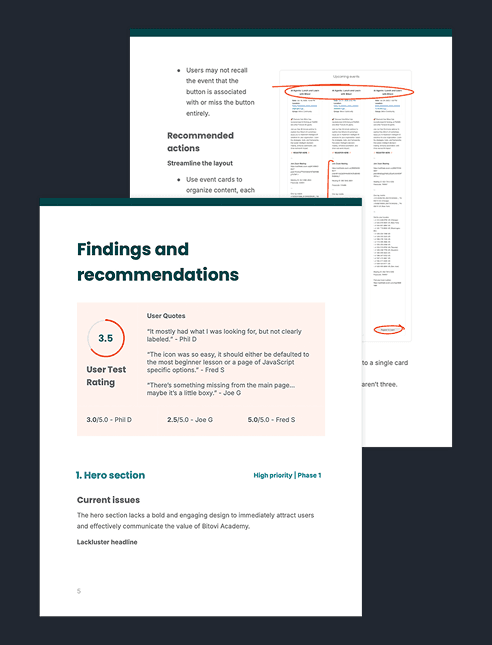
A UX/UI analysis report translates everything surfaced across the heuristic evaluation, accessibility audit, and usability testing into a structured, actionable deliverable your entire organization can use. For product leaders and IT consultancies presenting findings to stakeholders and engineering teams, the report is where the analysis becomes a roadmap for improvement.
Documenting Issues
Every identified issue is documented with a clear description of where the problem exists, what the problem is, and why it matters to the user experience. Screenshots and screen recordings are included to give stakeholders and engineering teams precise visual context and eliminate ambiguity about what needs to change to ensure nothing gets lost in translation between analysis and implementation.
Usability & Severity Ratings
Each documented issue is rated across two dimensions: usability impact and issue severity. Severity ratings draw from established usability research to categorize issues from cosmetic observations to critical blockers that prevent task completion. Usability impact ratings assess how broadly each issue affects your user base. Together these ratings give your team an objective basis for prioritization rather than relying on internal opinion or stakeholder preference.
Synthesized Report & Prioritized Action Items
All findings from the heuristic evaluation, accessibility audit, and usability testing are synthesized into a single consolidated report with prioritized action items your product and engineering teams can move on immediately. The report is structured for two audiences with an executive summary that communicates the strategic implications of the findings, and a detailed findings section that gives designers and developers the specific guidance they need to implement each recommendation effectively.
Contact
Reach out today and you’ll get a clear plan, honest advice, and a design expert that cares about the outcome as much as you do. Whether you prefer a quick call or a simple email, getting started is easy.